Visual Guide to Security Recipes
Use this page when you have a CVE or vulnerability finding and want the shortest path from source evidence to a reviewer-ready result. The complete database is broad; search-indexable canonical CVE pages are deliberately limited to records with reviewed Markdown or evidence-qualified remediation.
The path at a glance
Security Recipes is meant to be used as a loop:
- Search the CVE database or start from one named finding.
- Open the canonical record and confirm the affected surface.
- Select the smallest evidence-backed agent plan or remediation playbook.
- Return tests, source evidence, rollback, and stop conditions for review.
- Add read-only MCP context only when the agent needs runtime retrieval.
How a qualified CVE becomes discoverable
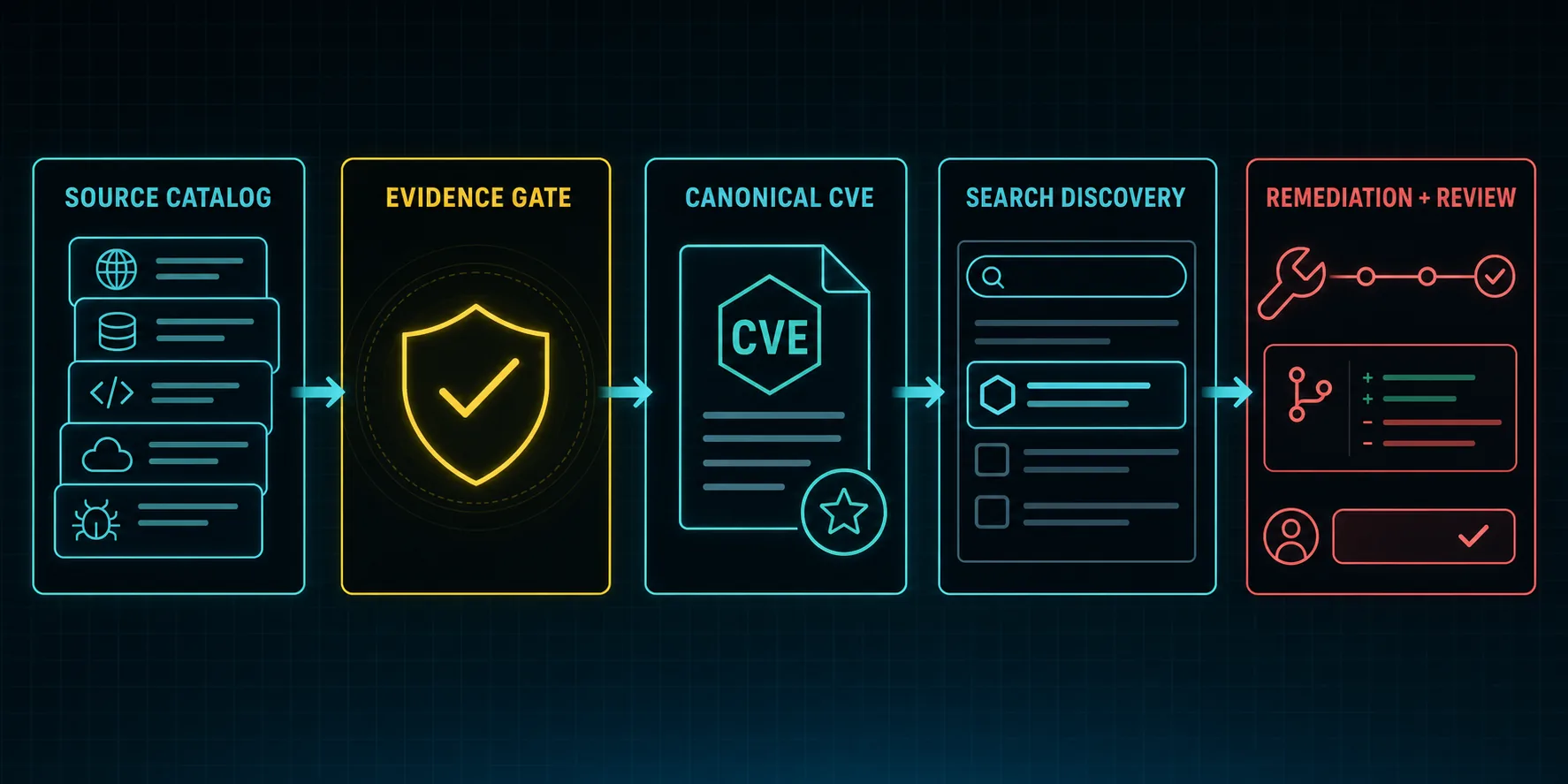
The tracked catalog and the public search surface are deliberately different.
Every in-scope record remains available in the database, but a canonical CVE
page is indexable only after reviewed Markdown or a complete enrichment passes
the deterministic remediation-evidence contract. Each qualified page owns one
canonical URL and arrives with a specific title and description, visible source
provenance, and Article, TechArticle, and BreadcrumbList structured data.
Search discovery is kept mechanically consistent with that policy. The CVE
database identifies the full catalog as a Dataset; the AI remediation pillar
describes its visible seven-step process as a HowTo; and year-partitioned CVE
sitemaps contain only canonical, indexable records. Build checks fail on missing
internal targets, sitemap/indexability drift, duplicate canonical ownership, or
unreachable pages. A rendered-body similarity gate also keeps highly templated
generated recipe children noindex,follow until they gain materially unique
evidence and examples. These controls make pages eligible and understandable
for crawlers, but no markup or sitemap can guarantee a particular search
position.
1. Search the CVE database
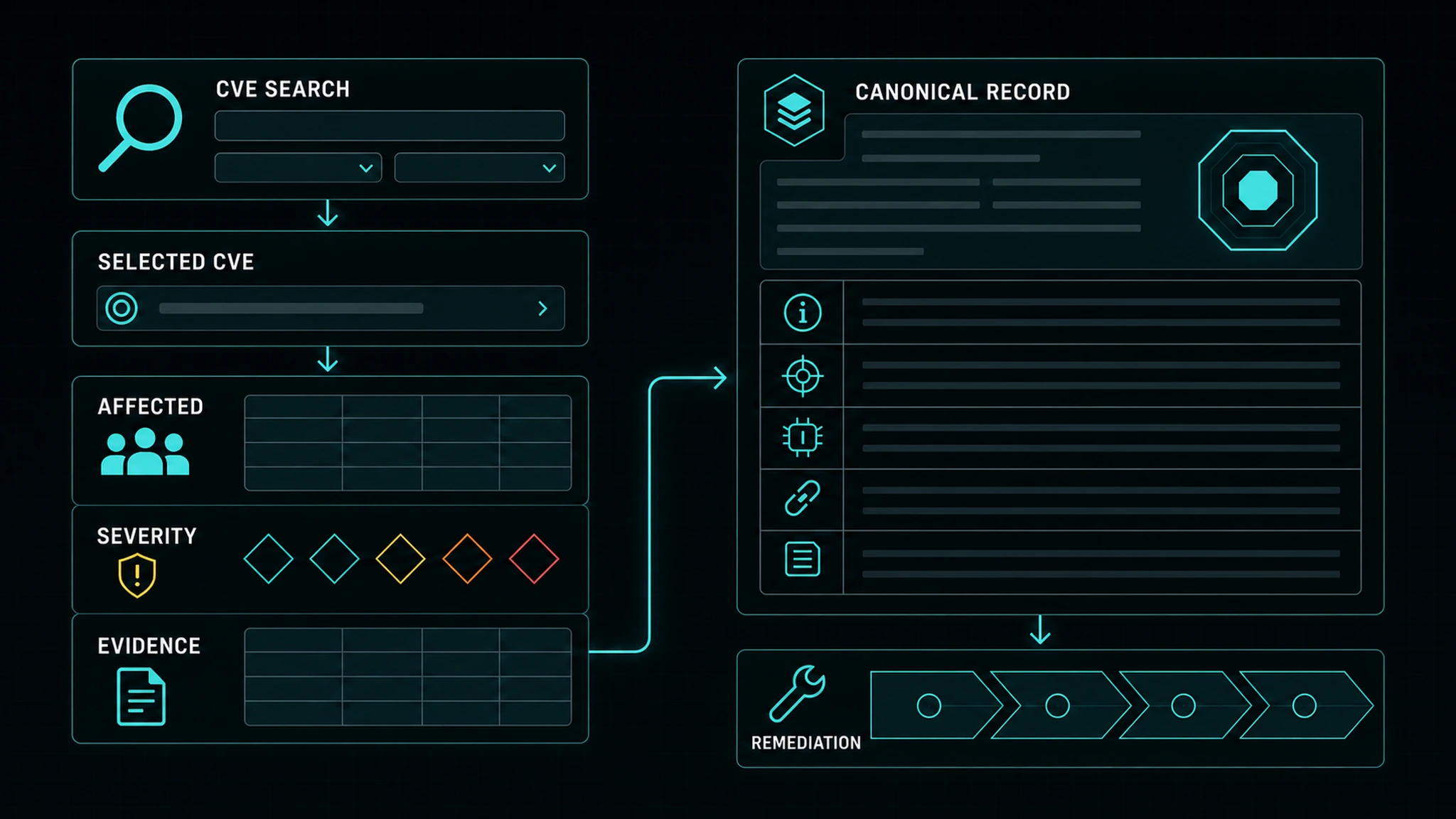
Start with the CVE Database when you have an
exact CVE ID, product, severity, ecosystem, or known-exploited status. The
database covers the complete tracked rolling ten-year Medium, High, and Critical
scope. A
canonical CVE page is narrower: it is published for search only after the
record passes the repository’s remediation-evidence policy. The page initially
shows its server-rendered latest records and calls the bounded, revision-pinned
search service only after you interact with search. Every result links to a
local CVE record. Evidence-qualified records are static and indexable; the
remainder use a bounded noindex runtime page that still cites the official
CVE.org source.
On a canonical record, the visible primary references and structured-data citations come from the same conservative source set. Multi-branch fixes keep all trusted fixed-release versions in the recommended action, so reviewing one branch does not silently hide the others. Essential facts and guidance arrive server-rendered; use Load complete machine-readable record only when you need the normalized payload and full action contract.
The Recipes library uses the same data-first pattern: its initial document contains 18 crawlable cards and loads the complete curated feed only after you search, filter, sort, open a filtered URL, or ask for more. The full JSON feed remains available for agents and offline consumers.
2. Turn evidence into a bounded plan
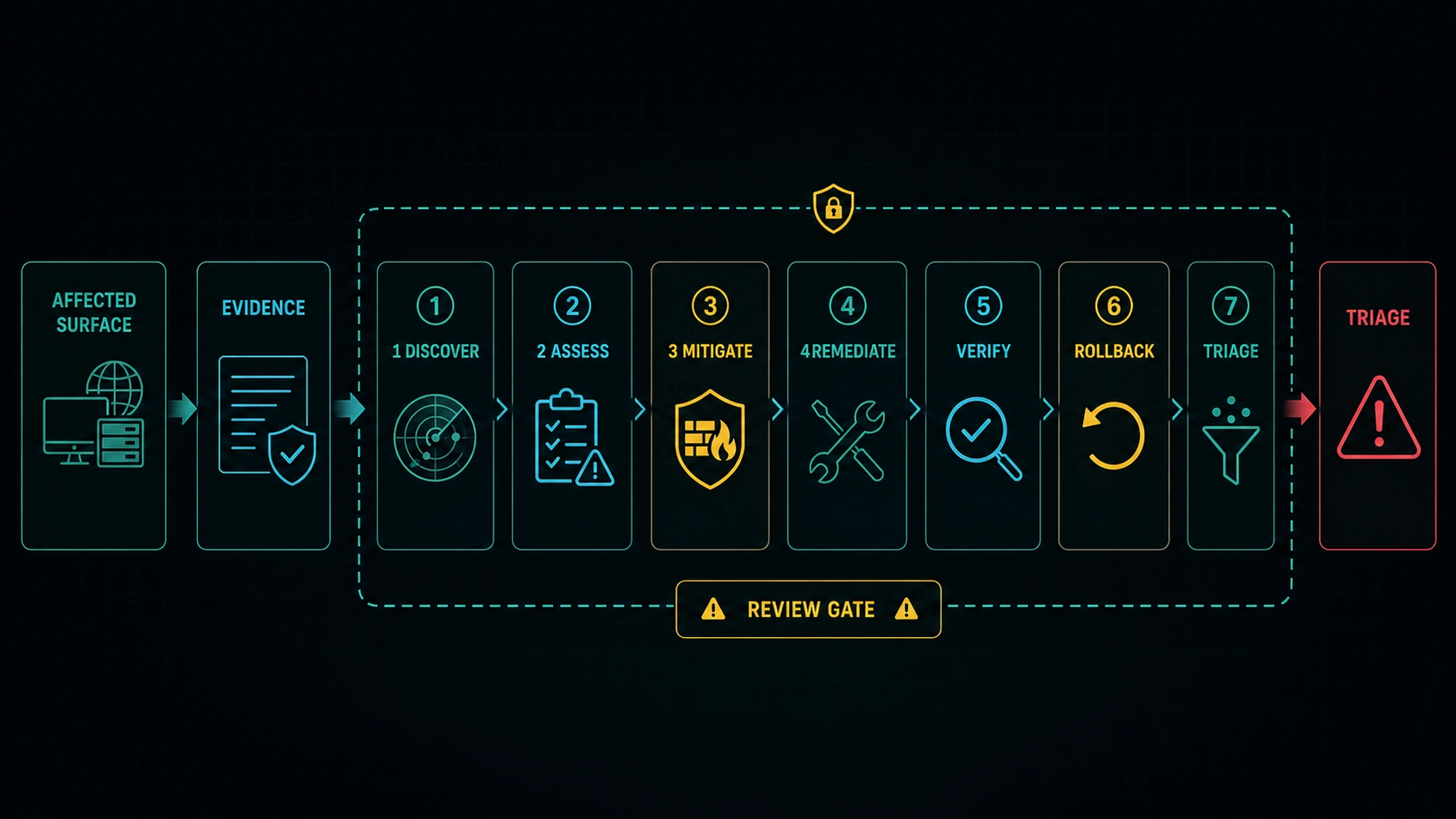
Confirm the affected asset, versions, exposure, and owner before asking an
agent to edit anything. Then use the verified
AI agent comparison to match the finding surface,
operating mode, expected artifact, prerequisites, and review gate. Load the
tool’s native instruction surface: AGENTS.md, CLAUDE.md,
.github/copilot-instructions.md, .cursor/rules/*.mdc, Devin’s repository
.agents/skills/<skill-name>/SKILL.md, Shiba Studio’s per-agent
instructions, a Hermes skill, or OpenClaw’s workspace AGENTS.md where
supported. The plan is context, not permission; repository
scope and every approval gate still apply.
If the finding is in the agent system itself—its tools, identities, memory, retrieved context, browser, MCP or A2A connections, or incident controls—use the separate AI Agent Security threat-model and control directory.
3. Return proof for human review
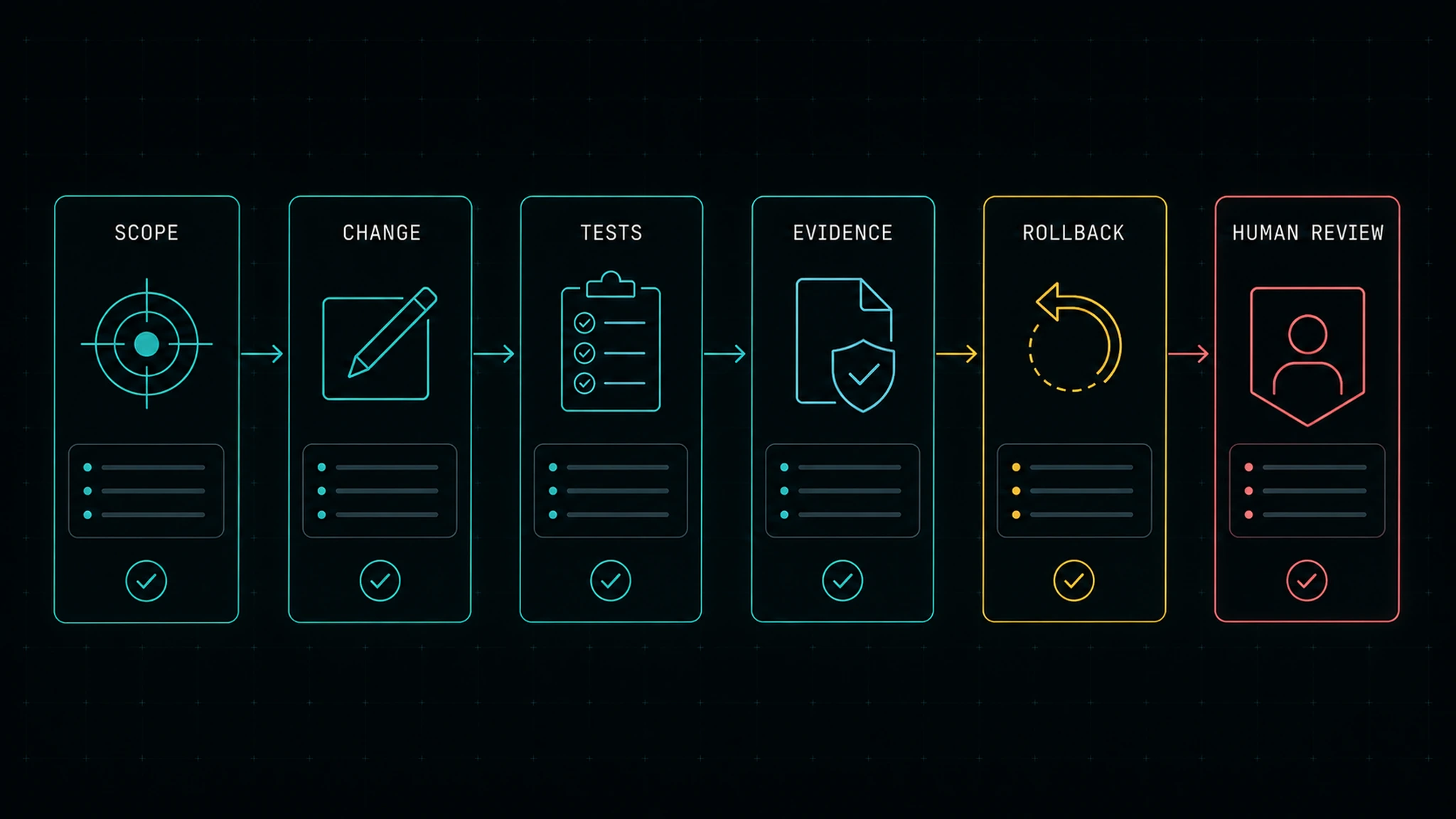
Use the AI Vulnerability Remediation Playbooks to define the finding, allowed files, verification, rollback, and stop conditions. The acceptable outcome is either a small, reviewer-ready change with evidence or a triage note that names the blocker and responsible owner. It is never an unreviewed production mutation.
For a public repository example, read the
CVE-2026-13149 brace-expansion case study.
It links the advisory, exact dependency change, regression test, pull request,
and recovery path. The case study also calls out the unrelated Fail2Ban work in
that pull request so the vulnerability evidence is not overstated.
4. Add read-only MCP context when needed
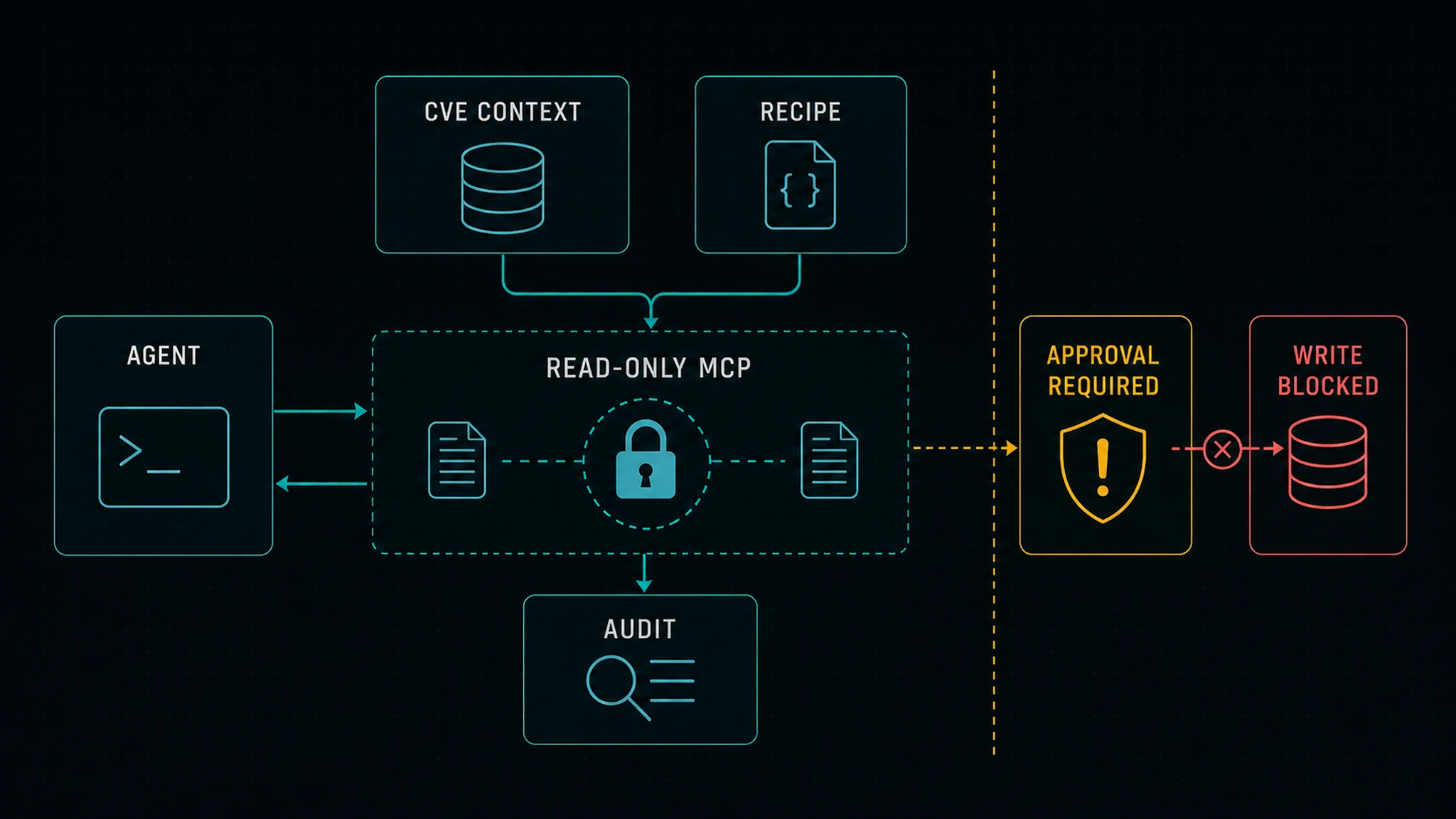
Use MCP when an agent needs structured recipe or CVE retrieval at runtime.
Keep the baseline read-only. Start with recipes_cve_search or
recipes_match_finding, then recipes_get or recipes_cve_get for the
bounded packet. Call recipes_quality_report when a recipe is missing
inputs, selection guidance, an output contract, verification, or
guardrails. Development leftover CVE dumps stay noindex and are not
catalog floors. recipes_cve_get must not invent a fixed version when
live GHAD is 404, vulnerabilities are empty, or NVD has no row.
Rechecked August 23, 2026: MCP
2026-07-28 is
still current and stateless. Connecting an organization-approved tool
can add context, but it does not authorize edits, ticket changes, secret
rotation, deployment, or any other external mutation.
What to read next
- CVE Database to search sourced records by ID, product, severity, ecosystem, or KEV status.
- Quick Start for the shortest path from one finding to one reviewed output.
- Agents if you already know which AI tool your team uses.
- Recipes if you need rules, skills, or prompts to copy into a repo.
- MCP Servers for read-only retrieval and separately approved enterprise connectors.
- Security Remediation if you are designing the full security-operated workflow.